GERM 331 / ARTS 386
Professor Christian J. Emden
E-Mail: emden@rice.edu
Office: Rayzor Hall 326
Office Hours: Thu 2:30-3:30 Professor Christina Keefe
E-Mail: ck1@rice.edu
Office: Hamman Hall 103B
Office Hours:
SOCIETY AND CRISIS
POLITICAL CULTURE IN THE WEIMAR REPUBLIC
SUMMARY
Germany of the 1920s and early 1930s offers a dazzling look at the possibilities and limits of modernity. Born out of the experience of the First World War and a political revolution that overturned traditional forms of authority, the Weimar Republic delivered one of the most liberal constitutions ever written, produced some of the most striking images and films of modern culture, and turned urban life into a spectacle of consumerism, architecture, fashion, and money. Yet, the Weimar Republic is also a time of political and social crisis: inflation, the ever present spectre of revolution, and a constitutional crisis that ultimately led to the rise of Hitler. No other period shows the ambivalence of modernity as clearly as Weimar Germany.
REQUIREMENTS
You should prepare for each class by reading the set texts. Making notes in advance will help you to focus on the discussion and formulate questions during class.
You are also required to actively participate in discussions and write TWO essays on topics to be announced. You are encouraged to come to office hours if you have questions relating to any part of the course, or if you wish to discuss your essays before final submission.
The final grade consists of:
Regular attendance, careful preparation, participation in discussion: 20 %
Two essays (10 pages each, word processed, double spaced): 80 %
In order to pass the course, all requirements need to be fulfilled!
Any student with a disability needing adjustments or accommodations is encouraged to speak with the professor during the first two weeks of class. All discussions will remain confidential. Students with disabilities are also required to contact the Disability Support Services in the Ley Student Center.
SYLLABUS
Aug 25 Introduction
TOWARDS CIVIL SOCIETY
Aug 27 Germany, 1918/19: Democracy or Dictatorship (Lecture by Christian J. Emden)
Sept 1 Max Weber and the Political
• Max Weber, “Politics as a Vocation,” in The Vocation Lectures, ed. David Owen and Tracy B. Strong, trans. Rodney Livingstone (Indianapolis, IN: Hackett, 2004), pp. 32-94.
Sept 3 Max Weber and the Political (cont.)
Sept 8 The Weimar Constitution
• http://www.zum.de/psm/weimar/weimar_vve.php/
• Richard Thoma, “The Reich as a Democracy,” in Arthur J. Jacobson and Bernhard Schlink (eds.), Weimar: A Jurisprudence of Crisis (Berkeley, CA: University of California Press, 2000), pp. 157-70.
Sept 10 No Class (Christian J. Emden is in Oxford, England)
Sept 15 Research and Resources in the Humanities (Workshop)
THE SPECTACLE OF MODERNITY
Sept 17 Neue Sachlichkeit—Writing Weimar
• David Midgley, Writing Weimar: Critical Realism in German Literature, 1918-1933 (Oxford: Oxford University Press, 2000), pp. 14-56.
• Selections from Bertold Brecht, Kurt Tucholsky, etc.
Sept 22 Berlin Cabaret Songs
• Songs by Mischa Spoliansky, Friedrich Hollaender, Rudolf Nelson, and Berthold Goldschmidt.
Sept 24 Berlin Cabaret Songs (cont.)
Sept 29 Photographic Realities, Social Images (Talk by Paul Hester, Visual and Dramatics Arts)
• Walter Benjamin, “Little History of Photography,” in Selected Writings, ed. Michael W. Jennings, vol. II (Cambridge, MA: Harvard University Press, 1999), pp. 507-30.
• Photographs by August Sander, Albert Renger-Patzsch, László Moholy-Nagy, etc.
Oct 1 Photography, Architecture, and the Order of Modernity (Talk by Paul Hester, Visual and Dramatics Arts)
Oct 6 Staging Bertold Brecht’s Three-Penny Opera (Presentation by Leslie Swackhamer)
Oct 8 No Class (Christian Emden is in Washington D.C.)
Oct 13 No Class (Mid-term Recess)
Oct 15 Film in Weimar Germany (Talk by Charles Dove, Visual and Dramatic Arts)
Oct 20 Fritz Lang, Metropolis, 1927 (Film Screening @ Rice Media Center)
Oct 22 The Politics of Cinema—Walter Benjamin
• Walter Benjamin, The Work of Art in the Age of Mechanical Reproduction, in Selected Writings, ed. Michael W. Jennings, vol. III (Cambridge, MA: Harvard University Press, 2002).
MONEY, SEX, AND CLASS
Oct 27 Money and Modern Society (Lecture by Christian J. Emden)
Oct 30 The Salaried Masses
• Siegfried Kracauer, The Salaried Masses: Duty and Distraction in Weimar Germany, trans. Quintin Hoare (London: Verso, 1998).
Nov 3 The Economy of Desire
• Irmgard Keun, The Artificial Silk Girl, trans. Kathie von Ankum (New York: Other Press, 2002).
• Janet Ward, Weimar Surfaces: Urban Visual Culture in 1920s Germany (Berkeley, CA: University of California Press, 2001), pp. 76-91.
Nov 5 Brecht’s Epic Theater and the Task of Social Criticism
CONSTITUTIONAL CRISIS
Nov 10 Hans Kelsen and the Value of Democracy
• Hans Kelsen, “On the Essence and Value of Democracry,” and Richard Thoma, “The Reich as Democracy,” in Arthur J. Jacobson and Bernhard Schlink (eds.), Weimar: A Jurisprudence of Crisis (Berkeley, CA: University of California Press, 2000), pp. 84-109 and 157-70.
Nov 12 Carl Schmitt and the State of Exception
• Carl Schmitt, Political Theology: Four Chapters on the Concept of Sovereignty, trans. George Schwab (Cambridge, MA: MIT Press, 1985), pp. 5-52.
Nov 13 Bertold Brecht and Kurt Weill, Three-Penny Opera, 1928 (Opening Night @ Hamman Hall)
Nov 17 Constitutional Endgames—Carl Schmitt in 1932
• Carl Schmitt, Legality and Legitimacy, trans. Jeffrey Seitzer (Durham, NC: Duke University Press, 2004).
Nov 19 Constitutional Endgames (cont.)
Nov 24 Politics as Myth
• Ernst Forsthoff, “The Total State,” and Reinhard Höhn, “Legal Community as National Community,” both in Arthur J. Jacobson and Bernhard Schlink (eds.), Weimar: A Jurisprudence of Crisis (Berkeley, CA: University of California Press, 2000), pp. 320-23
Nov 26 NO CLASS (Thanksgiving Recess)
Dec 1 Leni Riefenstahl, Triumph of the Will, 1935 (Film Screening @ Rice Media Center)
Dec 3 Final Discussion
Required Reading for Purchase
Walter Benjamin, Selected Writings, Volume III, ed. Michael W. Jennings (Cambridge, MA: Harvard University Press, 2002)
Arthur J. Jacobson and Bernhard Schlink (eds.), Weimar: A Jurisprudence of Crisis (Berkeley, CA: University of California Press, 2000)
Irmgard Keun, The Artificial Silk Girl, trans. Kathie von Ankum (New York: Other Press, 2002)
Siegfried Kracauer, The Salaried Masses: Duty and Distraction in Weimar Germany, trans. Quintin Hoare (London: Verso, 1998)
Carl Schmitt, Political Theology: Four Chapters on the Concept of Sovereignty, trans. George Schwab, foreword Tracy B. Strong (Chicago: University of Chicago Press, 2005)
Carl Schmitt, Legality and Legitimacy, trans. Jeffrey Seitzer, introd. John P. McCormick (Durham, NC: Duke University Press, 2004)
Janet Ward, Weimar Sufaces: Urban Visual Culture in 1920 Germany (Berkeley, CA: University of California Press, 2001)
Max Weber, The Vocation Lectures, ed. David Owen and Tracy B. Strong, trans. Rodney Livingstone (Indianapolis, IN: Hackett, 2004)
Recommended Reading for Purchase
Siegfried Kracauer, From Caligari to Hitler: A Psychological History of the German Film (Princeton: Princeton University Press, 1947) (newer edition available)
Detlev Peukert, The Weimar Republic: The Crisis of Classical Modernity, trans. Richard Deveson (London: Allen Lane, 1991)
 Click on the images to be brought to short videos!

 Marcel Slodki (1892-1943)


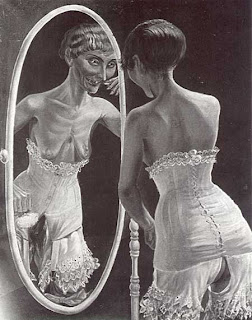


 Otto Dix (1891-1969), the great German Expressionist, was famous for his unique and grotesque style. Although Hitler's Nazi regime destroyed many of Otto Dix's works, the majority of his paintings can still be seen in museums throughout Germany.


